
All in a day s work

Opinion

All in a day s work

if one were to go by picture postcards, women in the Indian Himalaya are pretty and dainty, with rosy cheeks and soft hands. The reality, however, is quite different. The glow on their cheeks is a result of hard labour. And their soft hands are callused from the rough work that is part of their daily lives. The women of Kumaon, one of the two hill divisions of Uttar Pradesh, are no exception. In fact, they may be taken as representative of women in the mountain areas. They are pretty, but they are one of the most hard working women around.

For the rural women of Kumaon, a 20-hour work day is not uncommon. All across Kumaon, one can see women hard at work. The chores that are part of women's lives everywhere — cooking, cleaning, looking after children and the elderly — is only a small part of their chores. Collecting fuel wood, fetching water, making rope from hemp, conserving foodgrains for the next season, separating the rice from the husk, carrying the wheat to the water-driven panchakkis (water mills) for wheat flour and other such activities are routine, eating into their hours of rest and sleep.

Most women are not literate or educated. However, the average Kumaoni woman tries to spend some time with her children overseeing them in their studies. She invests the time to ensure that her children have a chance for a better life.

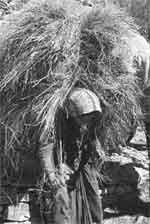
It is also up to the women to ensure that there is enough wood to keep the family warm through winter, and for cooking. The women move out in groups to collect wood and fodder for their livestock, travelling 3-10 km a day. Women carrying loads of wood and fodder on their heads and resting at the roadside are a common sight.

But it is not just the physical labour — headloads may weigh up to 15 kg — that makes their task difficult. Since the woodlands on the village commons are often degraded, women are forced to collect wood and fodder from other forests, usually on hillsides along the roads. Their activity may not harm the forests to the point where forest regeneration is affected. However, it is ‘illegal'. So they have to watch out for forest guards. Of course, there are other dangers — mainly, wild animals like tigers, mountain cats and bears. But, in their minds, the greatest risk is getting caught by the authorities and losing face.

Once, when I stopped over to photograph a group of women collecting wood, they objected. The idea, I told them, was to depict the life of the rural women in Kumaon, upon which they blurted out: " Gaon mein hum auraten bahut dukhi hain ' (We women in the villages are an unhappy lot). Having said so, she smiled guiltily. I looked up to see a woman walking down a hill slope, headload of fodder delicately balanced, knitting a sweater. Another was perched up a chir pine, some 20 feet above the ground, sickle in hand, furiously hacking at the thinner branches.

In fact, women gather even the pine needles that carpet the ground in chir forests. These are spread on the floor of animal sheds to keep the livestock warm. These and other leaves, mixed with dung, are transferred to compost pits and used later as manure on the terraced fields. All this is done by women. It is unfortunate that whatever little economic development has come about in the hills, it has helped men, and not women. Earlier, men trekked for miles across hostile terrain before reaching a roadhead. Now a bus is available at a roadhead near their village. But for women nothing has changed. They still get to do all the dirty work and life continues as usual — a drudgery.

Moving across Kumaon in the sowing season, one can see women carrying headloads of composted manure to their scattered land holdings, often eroded and kilometres apart. The returns from the hard work that they put in are barely enough to feed their household.

For her hard work to run a household, the Kumaoni woman is blamed for things beyond her control. The sacred forests around temples in the region, as opposed to other woodlands, are in a highly conserved state. "It's a woman's job to collect firewood,' says Mohan Singh of Chattai village, Almora district. "Since women are not allowed near some temples, the forests are automatically conserved.'

According to this view, women alone are responsible for forest degradation. However, this attitude just reinforces the simpler truth — that, but for the woman of the household, life in Kumaon would come to a standstill. That Kumaoni women care for their environment is evident from the way they lovingly tend their kitchen gardens. Small patches are sown with spinach, fenugreek, turmeric, coriander, radish, onions and potato. Vines of pumpkin and gherkin grow profusely in these gardens, which also cater to their taste for spicy food — chili bushes are a must. Trees of lemon, sweet lime, peach and plum border the small plot. Small groves of bamboo ( ringal ), which has its uses, are allowed to grow further away from the house — being associated with ‘the last journey'. These gardens help provide a fairly balanced diet throughout the year. Excess fruits and vegetables are sold in the village markets and the money used to buy groceries that are only available in exchange for paper money.

With winter around the corner, women get even more busy preparing for the long cold period ahead. Bathua , an edible leafy weed that grows along with wheat, has to be ‘harvested' around the time wheat starts sprouting. Grasses like doob and other fodder is hung on trees to dry so that livestock can be fed during the dry winters. But in such tasks cooperation and goodwill amongst villagers, especially neighbours, is a necessity.

Scarcity of vegetables in winter also means that they have to be preserved — again a woman's task. Pumpkins, potatoes, radish, leaves of fenugreek and other vegetables are left to dry in the sun on rooftops, which sport many colours just prior to winter.

Realising the value of hard cash and lack of job opportunities in the hills, Kumaoni men have been migrating steadily to the plains. A number of them have found employment in the armed forces. Over the years, what used to be a subsistence economy has become a ‘money order economy' — where the women manage households single-handedly, depending on money from their sons or husbands. The elderly are also left in their care. "The problems of the hills can be summed up in two words — pani aur jawani (water and youth),' says L M S Palni, director of the Govind Ballabh Pant Institute of Himalayan Environment and Development, Almora. "Retain both, prevent them from leaving, and many problems will be solved.'

But managing households on their own has taken its toll on the health of rural Kumaoni women. Most of them use wood stoves for cooking in kitchens that lack ventilation. Respiratory problems are common, and lack of proper medical attention only aggravates the situation.

But perhaps their pathetic condition can be depicted by a scene that few have seen. In the newly formed Champavat district near Pithoragarh, hill slopes are used for potato cultivation. To meet the water requirements of the cash crop, the hills are not terraced. It is impossible for bullocks to till this slope. And here — for want of men to perform the task — one can sometimes see a couple of women tied to a plough and pulling it, with a male guiding and pushing the plough from behind.

So next time the green grocer offers you pahari aloo (hill potato) and you buy it and enjoy its flavour, think of the kind of labour that has gone into cultivating it. You may want to pay a silent tribute to the women of the hills.

14/05/1998
Down to Earth 6 19980515

Footer Separator Box